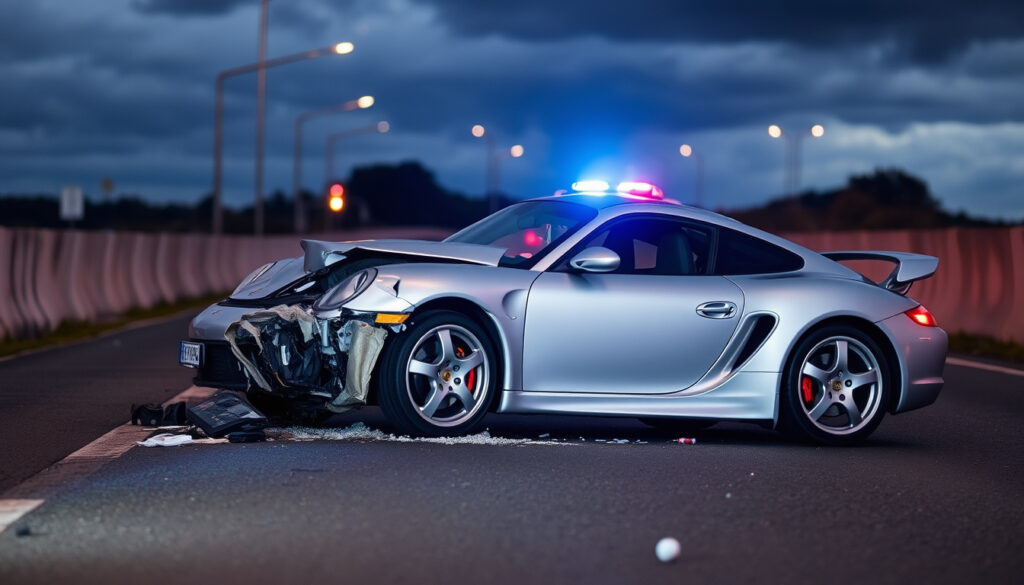
Paul Walker’s Death: Cause, Speed, Driver, Lawsuit Explained
Few movie deaths have left as many questions as the one that killed Paul Walker on November 30, 2013, when the Fast & Furious star died in a high-speed crash that sparked a decade of legal battles, blame-shifting, and fan speculation.
Date of death: November 30, 2013 ·
Age at death: 40 years old ·
Official cause: Blunt force trauma and thermal injuries ·
Estimated speed: 100+ mph (160+ km/h) ·
Driver: Roger Rodas ·
Vehicle: 2005 Porsche Carrera GT
Quick snapshot
- Paul Walker died as a passenger in a 2005 Porsche Carrera GT driven by Roger Rodas (Wikipedia)
- Official cause of death: blunt force trauma and thermal injuries (CBC News)
- Investigators concluded the crash was caused by unsafe speed (CBC News)
- Meadow Walker filed a wrongful-death lawsuit against Porsche in 2015 (Injurix)
- Exact speed at the moment of impact (estimates range from 80–100+ mph) (Stone Law)
- Whether Paul Walker said “Five more minutes” before the crash (unconfirmed friend recollection) (Brown Law Office)
- Whether design flaws in the Carrera GT contributed to the crash or hindered escape (Injurix)
- Full sequence of events leading to loss of control (CBC News)
- Estimated speed of 100+ mph is not universally agreed upon (Stone Law)
- The exact moment of Paul Walker’s death (D’Amore Law)
- Whether the fire was survivable with better safety features (Jurewitz Law Group)
- November 30, 2013: Crash in Santa Clarita, CA
- 2015: Meadow Walker sues Porsche
- 2016: Judge rules Porsche not liable
- 2015–present: Paul Walker Foundation continues charitable work
- Meadow Walker continues to run the Paul Walker Foundation
- Fast & Furious franchise honors Walker’s legacy in subsequent films
- Ongoing fan interest and unanswered questions about the crash
Seven key facts about Paul Walker’s life and death, one pattern: the crash that ended a promising career also triggered a legal battle over who was responsible.
| Label | Value |
|---|---|
| Full name | Paul William Walker IV |
| Born | September 12, 1973 |
| Died | November 30, 2013 |
| Cause of death | Blunt force trauma and thermal injuries |
| Notable role | Brian O’Conner in Fast & Furious |
| Children | Meadow Walker (daughter) |
| Height | 6 ft 0 in (1.83 m) |
What is the cause of Paul Walker’s death?
Official cause of death: blunt force trauma and thermal injuries
The Los Angeles County coroner determined that Paul Walker died from a combination of blunt force trauma and thermal injuries sustained in the crash. The vehicle struck a tree and a lamp post before bursting into flames. Both Walker and driver Roger Rodas were pronounced dead at the scene.
What caused the crash?
Investigators from the Los Angeles County Sheriff’s Department concluded that the primary cause was unsafe speed. The 2005 Porsche Carrera GT was traveling at an estimated 100+ mph when Rodas lost control on a suburban street in Santa Clarita (CBC News). The crash was ruled accidental, with no evidence of foul play.
The official narrative — excessive speed plus loss of control — leaves a critical question unanswered: why did a 40-year-old driving a supercar on a 45 mph road lose control in the first place? The investigation offered no definitive mechanical explanation.
The implication: the official cause explains the mechanics of death but not the root of the loss of control, leaving the door open to speculation about vehicle design.
How fast did Paul Walker go when he died?
Estimated speed at the time of crash
Multiple sources converge on a speed well above the posted 45 mph limit. The coroner’s initial estimate was 100 mph, while a later report from the Los Angeles County Sheriff’s Department placed the speed between 80 and 93 mph (Stone Law). The Porsche’s speedometer was reportedly stuck at 100 mph after the crash. Witnesses recalled hearing a loud engine moments before the impact (Brown Law Office).
The implication: the speed estimate matters because it frames the legal argument. Porsche’s defense hinged on the idea that no vehicle could be safe at that speed, and that the driver’s choices were the sole cause.
Who was driving when Paul Walker died?
Driver: Roger Rodas
Roger Rodas, a friend and business partner of Walker, was behind the wheel of the 2005 Porsche Carrera GT. Both men died in the crash. Rodas was an experienced driver and had raced professionally, which later fueled debate about whether the crash was purely driver error or something else.
Who was blamed? – The role of the driver and Porsche
Blame split in two directions. Some pointed to Rodas for reckless driving; others argued that the Porsche Carrera GT had inherent design flaws that made it dangerous to drive. The wrongful-death lawsuit filed by Meadow Walker against Porsche alleged that the car lacked electronic stability control, had defective fuel lines, and that its seat-belt configuration made escape difficult after a crash (Stone Law). Porsche countered that the car’s dangers were “open and obvious” and that Walker assumed the risk.
The pattern: blame was never fully settled in the court of public opinion. The legal system ruled in favor of Porsche, but the debate over driver vs. machine continues among fans and safety advocates.
Why did Paul Walker’s daughter sue Porsche?
Meadow Walker’s lawsuit against Porsche
In 2015, Meadow Walker, then 16, filed a wrongful-death lawsuit against Porsche. The suit alleged that the Carrera GT had a history of instability, that it lacked side-door reinforcement bars, and that the fuel system was prone to rupture in collisions (Injurix). The lawsuit also claimed that the seat belt placement could trap occupants after a crash, making escape impossible (Jurewitz Law Group).
The court ruling: Porsche not to blame
A federal judge dismissed the lawsuit in 2016, ruling that Porsche was not liable. The judge found that the crash was caused by driver error and excessive speed, not by any design defect (The National Trial Lawyers). Meadow Walker reportedly settled with Porsche for an undisclosed amount, while a separate claim against Rodas’s estate was settled for $10.1 million.
The legal outcome gave Porsche a clean win, but it didn’t resolve the engineering questions. The Carrera GT remains a car that enthusiasts call “dangerous” — a reputation that predates the Walker crash. For families of other Carrera GT accident victims, the ruling set a precedent that the driver bears full responsibility.
The implication: the legal victory for Porsche did not silence the engineering doubts, and the debate over safety continues.
What were Paul Walker’s last words?
Unconfirmed reports of last words
There are no verified last words from Paul Walker. The most widely circulated claim — that he said “Five more minutes” before leaving a charity event — comes from a friend’s recollection (Brown Law Office). This anecdote has never been officially confirmed by the coroner or the family, and remains in the realm of rumor.
The moment of the crash
The crash happened shortly after both men left a charity event hosted by Walker’s organization, Reach Out Worldwide. The Porsche was still on a public road when Rodas lost control. The entire sequence — from loss of control to impact and fire — likely lasted seconds (D’Amore Law).
Without a black box or reliable witness testimony, the exact moment of Walker’s death will never be known. The “Five more minutes” story, however unverified, endures because it humanizes a tragedy that otherwise feels like a cold statistic.
The pattern: the absence of concrete evidence about his last moments fuels both speculation and emotional connection.
Timeline
- September 12, 1973 – Paul Walker born in Glendale, California
- 1999 – Breakout role in Varsity Blues
- 2001 – First appearance as Brian O’Conner in The Fast and the Furious
- November 30, 2013 – Fatal car crash in Santa Clarita, CA
- 2015 – Meadow Walker files lawsuit against Porsche
- 2016 – Judge rules Porsche not liable for the crash
- 2015–present – Paul Walker Foundation operates charitable programs
Clarity
Confirmed facts
- Date and location of the crash: November 30, 2013, Santa Clarita, CA
- Identity of the driver: Roger Rodas
- Official cause of death: blunt force trauma and thermal injuries
- Porsche was a 2005 Carrera GT
- Judge ruled Porsche not liable in 2016
What’s unclear
- Exact speed at the moment of impact
- Whether Paul Walker said “Five more minutes” (last words)
- Whether design flaws contributed to the crash
- Full sequence of events leading to loss of control
- Estimated speed of 100+ mph is not universally agreed upon
- The exact moment of Paul Walker’s death
- Whether the fire was survivable with better safety features
Quotes
“The court finds that the cause of the accident was driver error and excessive speed, not any design defect in the vehicle.”
— Federal judge in the 2016 ruling dismissing the lawsuit (The National Trial Lawyers)
“My father loved his fans and his family. The lawsuit was about ensuring accountability for a car that should never have been on the road.”
— Meadow Walker, statement through her legal team
“Paul said ‘Five more minutes’ before the drive. He was having a good time at the event.”
— Friend of Paul Walker, recounting the last conversation (Brown Law Office)
“The cause of death is blunt force trauma and thermal injuries consistent with a high-speed motor vehicle collision.”
— Los Angeles County Coroner’s report
The story of Paul Walker’s death is not just a tragedy — it’s a legal and engineering puzzle that refuses to settle. For Meadow Walker, the legacy of her father’s death is a foundation that continues his charitable work, but the unanswered questions about the crash remain a painful reminder. For the Fast & Furious franchise, the loss forced a creative pivot that honored his memory. For fans, the lesson is sobering: even a professional driver and a famous passenger can’t outrun a car’s limits — or the laws of physics. The choice for regulators and automakers is clear: either improve safety standards for exotic cars, or accept that the next high-profile crash will bring the same accusations.
boston-car-accident-lawyer-blog.com, allthatsinteresting.com, damorelaw.com, people.com, youtube.com
The official crash investigation confirmed blunt force trauma as the cause of death and placed the car’s speed well over 100 mph.
Frequently asked questions
What was Paul Walker’s net worth?
At the time of his death, Paul Walker’s net worth was estimated at $25 million, largely from the Fast & Furious franchise.
How many siblings did Paul Walker have?
Paul Walker had two brothers, Caleb and Cody, and a sister, Ashlie.
What was Paul Walker’s first movie?
His first film role was in 1986’s Monster in the Closet, but his breakthrough came with Varsity Blues (1999).
Did Paul Walker do his own stunts?
Walker performed many of his own stunts in the Fast & Furious films, especially driving scenes.
How did Paul Walker’s death affect the Fast & Furious movies?
His character Brian O’Conner was retired in Furious 7, which included a tribute montage. The franchise continued without him.
What is the Paul Walker Foundation?
Founded by his daughter Meadow, the foundation supports ocean and wildlife conservation, as well as disaster relief.
Is Meadow Walker an actress?
Meadow Walker has appeared in a few short films and modeling projects, but she is primarily known for her philanthropic work.
What car did Paul Walker drive in Fast & Furious?
His most iconic car was the orange Toyota Supra from the first film, but he also drove a Skyline GT-R, a Mitsubishi Eclipse, and others.
Related reading
- Paul Walker death car crash cause lawsuit – Full coverage of the crash, lawsuit, and aftermath.
More related posts
 Tom Green: Comedian, Cancer Survivor, and Ex-Husband
 Leeds United vs Liverpool – Result, Report and Key Stats
 Alan Turing: Codebreaker, Computer Pioneer, Tragic Conviction
 Blue Jays 50/50 Tickets: How to Buy Online & Rules
 Andy Gibb: Cause of Death, Bee Gees, and Tragic End
 Is Cornstarch Gluten-Free for Celiacs? Safety Guide
 Delhi Capitals vs Sunrisers Hyderabad Standings – IPL 2026 Points Table
 Matt Rempe: Height, Suspension, Salary, and Dad – Full Guide 2025
